Why Is My Roof Going Black?
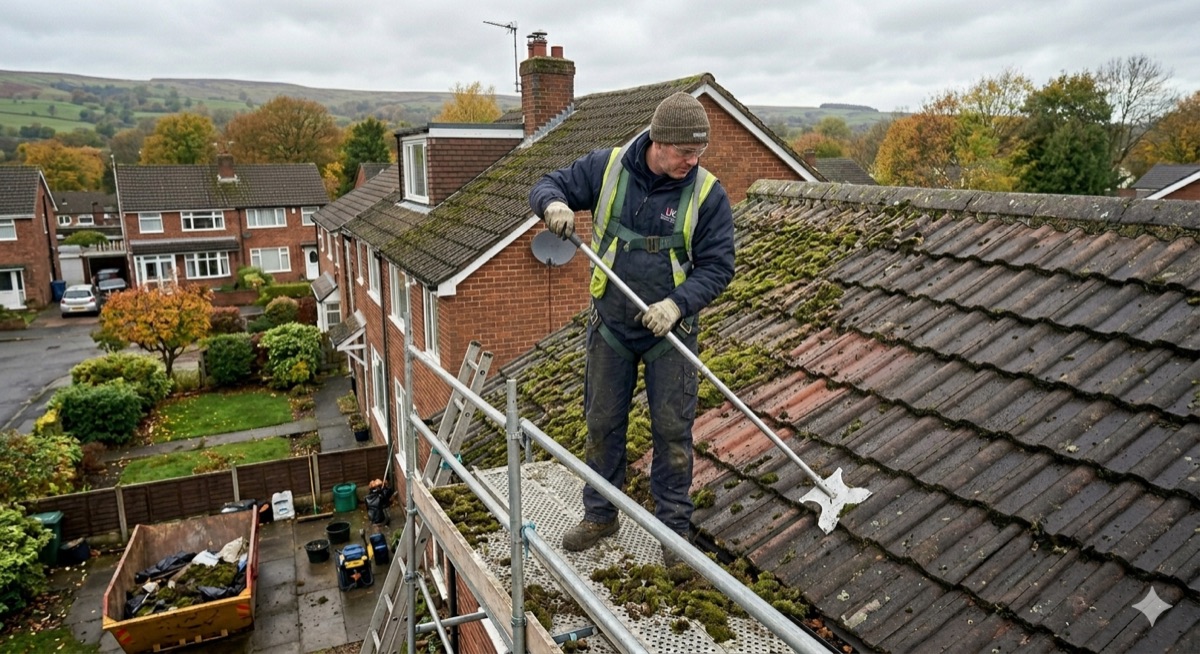
One year your roof looks fine; a few years on it's streaked with black and green, and the north slope is carpeted in moss. It's one of the most common questions we're asked in Chelmsford — so here's exactly what's happening up there, whether it matters, and how to deal with it safely.
What the black staining actually is
The dark streaking and patches are almost always algae — a hardy organism that spreads across roof tiles and shows as black or dark-green staining. Like the algae on render, it lives on moisture, light and the minerals in the tile surface, and it spreads by airborne spores. That's why it so often appears on several houses in a street at once: once it's in the area, it colonises every damp roof it can reach.
Alongside it you'll usually find moss — the thick green cushions that build up along tile edges and in the valleys, heaviest on the shaded, north-facing slope.
Why north-facing roofs are always the worst
It comes down to one thing: how long the roof stays damp. North and east-facing slopes get the least sun, so they dry slowest and stay wet for longer after rain and dew. Add overhanging trees (shade plus falling debris that holds moisture) and you've created ideal conditions. In the damper parts of Essex — low-lying areas near the rivers, and the humid air around Maldon and the Blackwater — roofs green up faster than average.
Is it actually damaging the roof — or just ugly?
This is the important bit, because the two growths behave differently:
- Moss can genuinely damage tiles. It holds water against the surface, and when that water freezes in winter it expands and can crack or flake (spall) the tile face, especially on older concrete tiles. Over years this shortens the roof's life.
- Moss blocks gutters. Clumps break loose, slide down and pack into gutters and downpipes, causing overflows that then run down — and stain — your render and fascias.
- Black algae is mostly cosmetic, but it's a clear sign the roof is staying damp, which is exactly the condition moss needs. So it's a useful early warning.
So it's not just about looks. Left for years, a heavily mossed roof can mean cracked tiles and blocked drainage — both more expensive to fix than a clean.
Why you shouldn't pressure wash a roof
It's a common and costly mistake. Roof tiles — particularly concrete ones — have a protective surface layer and, on some types, a granular finish. High pressure strips that surface away, leaving the tile rougher, more porous and quicker to re-soil. It can also force water up under the tiles into the roof space, and knock tiles out of position. A pressure-washed roof often looks dramatic on the day and then deteriorates faster than before.
The safe way to clean a roof
Proper roof cleaning and moss removal is a two-stage job:
- Moss removal — physically clearing the moss by hand and with controlled, low-pressure tools, working safely without damaging tiles.
- Biocide treatment — applying a treatment that kills the remaining algae and moss spores at the root, so regrowth is dramatically slowed.
Done this way, the roof is cleared without the damage a pressure washer causes, and because the spores are killed rather than just scraped off, it stays clean for years. It's also far safer — done from the right access equipment by someone insured to work at height, rather than you on a ladder.
How to slow it down
- Keep gutters clear so water drains away cleanly rather than backing up onto the roof edge.
- Cut back overhanging branches to let the roof dry and reduce falling debris.
- Deal with moss before it gets thick — a light covering is far quicker and cheaper to treat than years of heavy growth.
- Consider a periodic biocide top-up on north-facing slopes to keep regrowth in check.
Frequently asked questions
Why is my roof going black?
The black staining is almost always algae — a hardy organism that spreads across tiles as dark streaks and patches. It thrives on damp, shaded, north-facing roofs and spreads by airborne spores, which is why neighbouring roofs are often affected too.
Is moss or black algae damaging my roof?
Moss can be — it holds water that freezes and can crack tiles over time, and it blocks gutters. Black algae is mostly cosmetic but signals the damp conditions that let moss take hold, so it's worth addressing.
Should you pressure wash a roof?
Generally no. High pressure strips the protective tile surface, forces water under the tiles and can dislodge them. The safe method is moss removal plus a biocide treatment that kills regrowth at the root.
How long does a roof clean last?
After moss removal and treatment, a roof typically stays clear for several years depending on trees, aspect and tile type. North-facing roofs under trees regrow fastest; a treatment top-up every few years keeps it under control.
Related: Roof cleaning & moss removal · Gutter clearing · How to remove green algae from render